
Table of Contents
EXTERIORVIBE.BIZ.ID – The Steam Deck, Valve’s innovative handheld gaming PC, has revolutionized how players access their Steam library on the go. Understanding the Steam Deck specifications is crucial for appreciating its capabilities and determining if it meets your gaming needs.
This powerful device blends PC flexibility with console-like portability, offering a unique gaming experience wherever you are. Its robust hardware is specifically engineered to run a vast array of modern PC titles efficiently.
Core Processing Power: CPU and GPU
At the heart of the Steam Deck lies a custom AMD APU, designed for optimal performance in a compact form factor. This APU integrates both the central processing unit (CPU) and the graphics processing unit (GPU) onto a single chip.
The CPU is a 4-core, 8-thread Zen 2 processor, clocking in at 2.4-3.5 GHz, providing ample power for demanding game logic and background tasks. Complementing this, the GPU is an 8 RDNA 2 CUs graphics processor, running between 1.0-1.6 GHz, capable of delivering impressive visuals on its portable screen.
Memory and Storage Solutions
The Steam Deck is equipped with 16 GB of LPDDR5 RAM, operating at a swift 5500 MT/s, ensuring smooth multitasking and quick asset loading for games. This high-bandwidth memory is vital for modern titles that often require significant system resources.
For storage, Valve offers several options: a 64 GB eMMC, 256 GB NVMe SSD, or a 512 GB high-speed NVMe SSD, with the LCD and OLED models having distinct configurations. All models also feature a microSD card slot, allowing for expandable storage to accommodate an ever-growing game library.
Display and Visual Experience
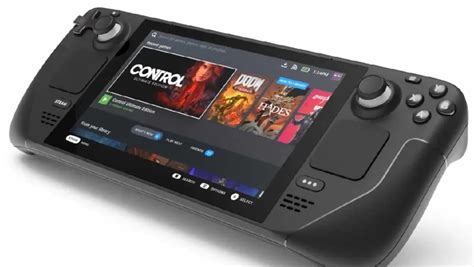
The original Steam Deck features a 7-inch LCD IPS display, offering a resolution of 1280 x 800 pixels with a 60 Hz refresh rate. This screen provides clear and vibrant visuals for an immersive handheld gaming experience.
The newer Steam Deck OLED models elevate this further with a larger 7.4-inch OLED HDR display, boasting improved brightness, contrast, and color accuracy, alongside a smoother 90 Hz refresh rate, truly enhancing the visual fidelity for compatible games.
Battery Life and Connectivity
Battery capacity varies slightly between models; the original LCD version uses a 40 Whr battery, while the OLED model features a larger 50 Whr battery. This allows for approximately 2-8 hours of gameplay, depending on the game’s demands and settings.
Connectivity options are comprehensive, including Wi-Fi (Wi-Fi 5 for LCD, Wi-Fi 6E for OLED), Bluetooth 5.0 (5.3 for OLED), and a USB-C port that supports power delivery, DisplayPort 1.4 alt mode, and USB 3.2 Gen 2, enabling external display output and accessory connections.
Operating System and Controls
The Steam Deck runs on SteamOS 3.0, a custom Linux-based operating system optimized for gaming and featuring Valve’s Proton compatibility layer for Windows games. This provides a user-friendly interface tailored for handheld use, alongside desktop mode functionality.
Its integrated controls are robust, featuring dual analog sticks, a D-pad, ABXY buttons, shoulder buttons, and four rear paddle buttons, along with haptic feedback and dual trackpads for mouse-like precision in PC games not optimized for controllers. These comprehensive input methods make it highly versatile for various game genres.
Written by: William Clark
